Where, exactly, do words reside? The obvious answer is ‘in the mind,’ but where is that, precisely? Dr. Michael W. Kibby (who was my dissertation advisor) jokes that word knowledge is housed ‘in the liver’ (cf: Kibby, 1995). This is his humorous way of suggesting that there is far from universal agreement about where an individual’s word knowledge is stored and how it is organized. Here are some things I’ve learned since Dr. Kibby inspired my word-nerdish curiosity.
Each individual possesses vast banks of knowledge about the world in which he lives. Many cognitive scientists (philosophers, psychologists, linguists, artificial intelligence experts, etc.) have theorized that individuals construct and organize their knowledge according to the associations that they make between discrete bits of information — linguistic, sensory, experiential, associational, etc. Cognitive scientists refer to these packets of organized associations and knowledge as schemata, schemes, or scripts.
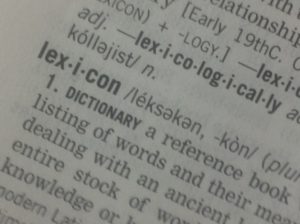
Much of an individual’s knowledge about the world is represented mentally with language. Cognitive linguists have theorized that knowledge about words is organized in a space called ”the mental lexicon.” This mental lexicon is a theoretical construct – we know that the human brain has a tremendous capacity for knowledge acquisition, storage, and retrieval, but we can’t point to just one part of the brain and say that all word knowledge is stored there. So when scholars talk about this theoretical mental lexicon, they tend to compare it metaphorically to other more familiar things, like dictionaries, encyclopedias, semantic webs, and databases.
For example, many people think of their own word knowledge as being stored in a sort of dictionary in their minds (Miller, 1986). That metaphorical comparison leads to an oversimplified understanding of the types of knowledge individuals possess about words. The dictionary metaphor also leads to an overgeneralization. Dictionaries provide the same types of information for every entry. But individuals possess varying levels of knowledge about individual lexical items, and each entry in an individual’s mental lexicon does not necessarily include the types of things one would find in a dictionary. (I will elaborate on this topic in my post titled, “What does it mean to know a word?”)
There are a number of different theories about the mental lexicon, all quite interesting to consider, from my vantage point as a word-nerd (cf: Aitchison, 2012; Bloom, 2000; Jackendoff, 2002; Miller, 1986, 1996, 1999; Miller & Feldbaum, 1991; Miller & Gildea, 1987; Nagy & Scott, 1990; Pinker, 1994, 1999). Perhaps surprisingly to the non-nerd, the structure and organization of the theoretical mental lexicon is the topic of vigorous scholarly debate. Cognitive psychologists take a different approach to modeling the mental lexicon than do cognitive linguists, and computational linguists take a different approach than do the cognitive folk. However, there is a general consensus across theories with regard to the possible contents of the mental lexicon. (This is another topic upon which I will elaborate in my next post titled, “What does it mean to know a word?”)
For our purposes as teachers and learners, it is important to know that the term mental lexicon refers to an individual’s mental storehouse of word knowledge. Always remember that word knowledge is highly idiosyncratic (it varies widely from individual to individual). The mental lexicons of individuals raised in similar environments (linguistically, educationally, socioculturally) would obviously overlap quite a bit. However, much of an individual’s knowledge is constructed through his or her literacy experiences, and since we know students literacy experiences are highly variable, it makes sense that lexical (word) knowledge is also highly variable. It is important to remember that every aspect of’ word knowledge in an individual’s mind could be correct, partially correct, or even incorrect. So word knowledge might best be described as a collection of beliefs about a specific word. This is where I will pick up the discussion in my next post. In the interim, happy reading!
References
Aitchison, J. (2012). Words in the mind: An introduction to the mental lexicon (4th ed.). Hoboken, NJ: Wiley-Blackwell.
Bloom, P. (2000). How children learn the meanings of words. Cambridge, MA: A Bradford Book, The MIT Press.
Jackendoff, R. (2002). Foundations of language. New York: Oxford University Press.
Kibby, M.W. (1995). Things and the words that signify them. Journal of Adolescent and Adult Literacy, 39(3) 208-223.
Miller, G. A. (1986). Dictionaries in the mind. Language and Cognitive Processes, 1(3), 171- 185.
Miller, G. A. (1996). The science of words. New York: Scientific American Library.
Miller, G. A. (1999). On knowing a word. Annual Reviews of Psychology, 50, 1-19.
Miller, G. A., & Feldbaum, C. (1991). Semantic networks of English. Cognition, 41, Special Issue: Lexical and conceptual semantics (1-3), 197-229.
Miller, G. A., & Gildea, P. M. (1987). How children learn words. Scientific American, 257, 94-99.
Nagy, W. E., & Scott, J. A. (1990). Word schemas: Expectations about the form and meaning of new words. Cognition and Instruction, 7(2), 105-127.
Pinker, S. (1994). The language instinct: How the mind creates language. New York: Harper Collins.
Pinker, S. (1999). Words and rules: The ingredients of language. New York, NY: Basic Books.
COPYRIGHT © 2015 KAREN M. WIELAND, Ph.D | ALL RIGHTS RESERVED